


Observatory
Chengdu Jindu Superstar Astronomy Equipment Co.,Ltd is the professional manufacturer in observatory equipment producing and installation. Our products are applicable to all kinds of schools, science centers, science museums, theme parks, dome theaters. This provides an unparalleled level of uniformity for the projection screen.
Why Choose Us
Rich Experience
Since its establishment in 1965, with decade constant efforts, our factory has developed the strong and professional manufacturer in optics, mechanics and electronics products’ developing and producing, making great contributions to our national defense, basic education and astronomical science promotion.
Professional Team
We have the special production shop, assembly shop and adjustable planetarium hall. We have the professional administrative staff, technical engineers, designer, operators and installers.
Global Market
We sale our products to the markets at home and abroad. So far, we share 85% domestic markets, over 300 sets planetariums and dome theaters installation. At abroad, there are some dome screen construction projects in France, Korea, Malaysia and Thailand and so on.
Good Service
Establish perfect manufacture and site construction administrative system, arrange experienced staffs to go on site construction. Have the professional staff to deal with all kinds of after-sales problems via email, telephone, fax and so on.


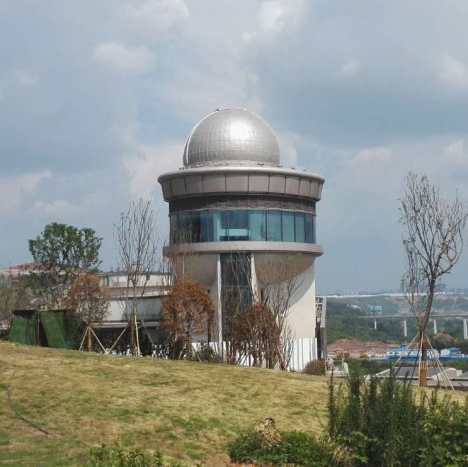


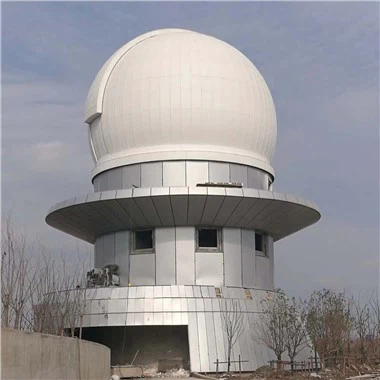

Observatory
Types of Observatory
Dome Astronomical Observatory
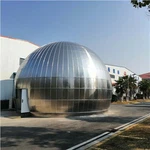
The dome astronomical observatory manufactured by our company adopts steel frame support, outer mask stainless steel (or aluminum panel), Inner mask color steel plate (can be specially designed according to user requirements mask scheme), and the horizontal rotation adopts friction drive or sprocket drive mode.
Ash Dome Observatory
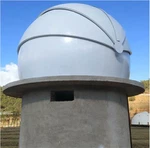
The ash dome observatory manufactured by our company is a spherical dome used for effective protection of astronomical telescopes.
Observatory Dome
The observatory dome is a metal structure used to protect the fixed astronomical telescope from water and dust.
Astronomy Domes Observoatories
The astronomy domes observatories is a metal structure used to protect the fixed astronomical telescope from water and dust.
Telescope Observatory Dome
The telescope observatory dome is a kind of semi-spherical or super-hemispherical metal building used to protect the fixed astronomical telescope from water and dust.
Telescope Observatory
The telescope observatory is a semi-spherical or super-hemispherical metal structure used to protect fixed astronomical telescopes and other optical observation equipment from water and dust.

The observatory manufactured by our company is made of steel frame supporting structure, stainless steel (or aluminum plate) with outer thickness of 0.8mm-1mm, and colored steel plate (or aluminum plate) with inner thickness of 0.5mm (special mask scheme can be designed according to user requirements).
The horizontal rotation adopts friction drive or sprocket drive to realize horizontal 360°positive and negative rotation.
The skylight adopts arc climbing window-type design, with good waterproof and dustproof characteristics. Arc climbing window adopts sprocket drive mode. The opening angle of the skylight is 5°-- 95°.
The opening width of the skylight can be specially designed according to the needs of the telescope.
Data Collection: Observatories gather vast amounts of data about celestial objects, such as stars, galaxies, and exoplanets, contributing to our understanding of the universe.
Long-Term Observations: They enable long-term studies of astronomical phenomena, such as variable stars, supernovae, and the dynamics of galaxies.
Collaboration: Many observatories facilitate collaboration among scientists worldwide, leading to shared knowledge and resources.
Innovation: Observatories often drive advancements in technology, including imaging techniques, spectrometry, and data analysis tools, which can have applications beyond astronomy.

Difference between Planetarium and Observatory
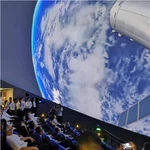
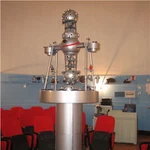
Observatory are research institutions, planetariums are educational institutions. An observatory explores the universe, a planetarium communicates the research results of the observatories. In an observatory, the telescopes are usually located under a dome that is opened for observations. In a planetarium, a projector is located under a dome that generally remains closed. Activities in an observatory are weather dependent. The shows in a planetarium run independently of the weather.

The base area must be carefully selected and prepared for both power and connectivity. Thus, the proper conduits and wiring must be pre-positioned prior to the assembly of the dome pieces.
Measure the dimensions of your telescope, including its length, width, and height, and ensure that the dome you select can accommodate it comfortably.
Ensure that the observatory has a reliable sealing mechanism to prevent water leakage and ingress of dust particles.
Implement heating, ventilation, and air conditioning (HVAC) systems to maintain stable internal conditions and prevent condensation.
Make sure the dome observatory has proper locking mechanisms and security features to protect your valuable telescope and equipment from theft or unauthorized access.
Customization Process
Detailed design
Our designers use 3D modelling software to create a 3D model of the products required. This is then sent to our customers for checking. If any changes are required the design may go through a few iterations until everyone is happy with the final version and then this is signed of by our customers.
Confirm the design
Once our customer has agreed to the detailed design we then design a manufacturing level model. This model details the support structure, the frame and the panels, right down to where holes will be and what size fixings will be used.
Manufacturing
During the initial discussion pre-contract we will give an indication of the manufacturing time needed for the screen. Depending on the factory loading, manufacturing can be very fast and efficient. Our customers are kept informed of progress and are given dates in advance for when their product will be ready for shipping.
Quality Control
Every step of our products manufacture and installation is strictly monitored to ensure that all of the elements meet our very high standards. Anything that does not meet our very high standards is redone to ensure our products are the highest quality available.
Logistics
We offer the option of having products shipped to site and will provide accurate delivery information to our customers prior to product delivery. This service combined with design, manufacture and the installation process means that our customers don’t have the stress or problems that can arise through unforeseen circumstances.
Installation
We supply a fully trained installation team who are experts at what they do. On some larger installations we may require some local labour to give unskilled assistance, but this is rare and specified before the contract is signed.
Handover
At the end of each installation the end client and our customer are invited to inspect the quality of workmanship and identify any items that they are not happy with. Any items that need to be rectified are done there and then and then the product is signed off.
MOQ: Depending on your item shape and material, the MOQ is about 1 piece.
Payment: We agree TT in advance, LC, Paypal, Western union, all ok.
Shipping: We send orders by air and sea.
Delivery Time: The lead time depends on the type/model and the total number of units you are ordering. So it may be as short as 8 weeks or as long as 20 weeks. If your order includes personalized customizations, it could take even longer, depending on the final design.
Packaging: The products are carefully packed in large wooden boxes. The size and quantity of wooden boxes depend on the number of product configurations. The box is filled with cushioning material to prevent damage from conduction or vibration.
