


Hey there! As a supplier of planetarium projectors, I often get asked this question: Can a planetarium projector project the solar system? Well, let's dive right into it and explore the ins and outs of this fascinating topic.
First off, let's understand what a planetarium projector is. A planetarium projector is a device that can project images of celestial objects onto a dome or a flat surface. There are different types of planetarium projectors, and one of the most well - known is the Optical Planetarium Projector. These projectors use a combination of lenses, mirrors, and light sources to recreate the night sky with high precision.
Now, back to the main question: Can it project the solar system? The short answer is yes, but it's a bit more complicated than that.
How a Planetarium Projector Can Project the Solar System
Planetarium projectors are designed to mimic the appearance of the night sky as seen from Earth. When it comes to the solar system, they can project the positions of the planets, the Sun, and the Moon at a specific time and location.
Most modern planetarium projectors are equipped with software that allows for accurate simulation of the solar system. The software takes into account the orbits of the planets, which are governed by Kepler's laws of planetary motion. These laws describe how planets move in elliptical orbits around the Sun, with the Sun at one of the foci of the ellipse.
The projector uses this software to calculate the exact positions of the planets relative to the Earth. For example, it can show you where Mars will be in the sky tonight, or how the positions of the planets change over the course of a year.
In addition to the planets, a good planetarium projector can also project other features of the solar system, such as the phases of the Moon. The Moon goes through different phases as it orbits the Earth, and the projector can accurately reproduce these phases. It can also show phenomena like eclipses, both solar and lunar. A solar eclipse occurs when the Moon passes between the Earth and the Sun, blocking the Sun's light. A lunar eclipse happens when the Earth passes between the Sun and the Moon, casting a shadow on the Moon.
Limitations and Challenges
While planetarium projectors can do an amazing job of projecting the solar system, there are some limitations.
One of the main limitations is the scale. In the real solar system, the distances between the planets are vast. For example, the distance from the Earth to the Sun is about 150 million kilometers, and the distance from Neptune to the Sun is about 4.5 billion kilometers. It's impossible to accurately represent these distances on a planetarium dome. So, the projector has to use a scaled - down version of the solar system. This means that the relative distances and sizes of the planets are not exactly the same as in reality.
Another challenge is the level of detail. While the projector can show the general positions of the planets, it may not be able to show all the fine details. For example, some planets have complex atmospheres with clouds and storms. The Great Red Spot on Jupiter is a massive storm that has been raging for centuries. While a high - end planetarium projector may be able to show a simplified version of this storm, it can't show all the intricate details that we can see with powerful telescopes.
Different Types of Planetarium Projectors for Solar System Projection
There are several types of planetarium projectors that can be used to project the solar system.
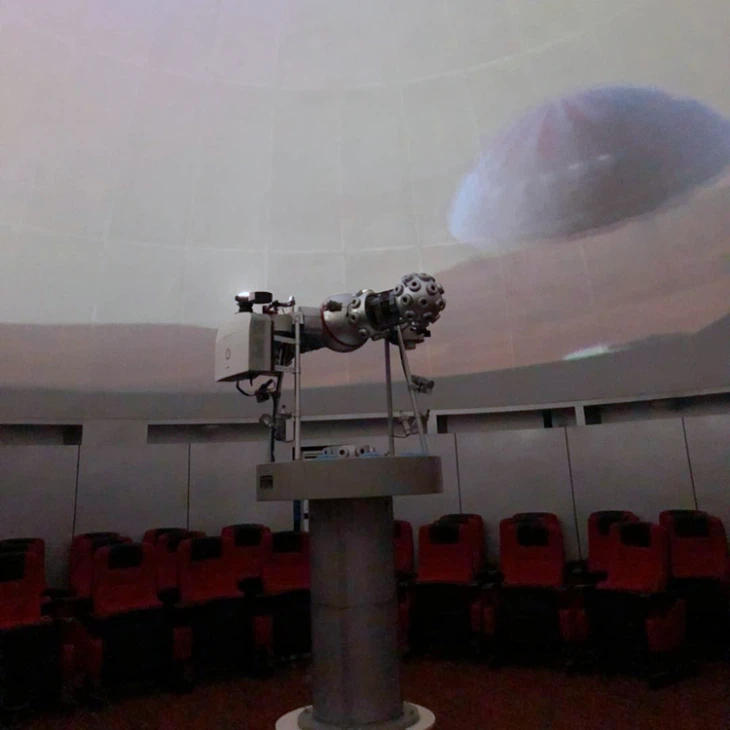
As mentioned earlier, Optical Planetarium Projectors are great for creating a realistic and immersive experience. They use optical elements to project the stars and planets onto the dome. These projectors are often used in large - scale planetariums because they can provide a high - quality image.
Digital planetarium projectors are also very popular. These projectors use digital technology to create the images. They are more flexible than optical projectors because they can easily update the software to show the latest astronomical data. Digital projectors are often used in smaller planetariums, schools, and museums.
Then there are Dome Planetariums. These are complete systems that include a dome and a projector. They are designed to provide a fully immersive experience of the solar system and the night sky. Dome planetariums can be customized to fit different spaces and budgets.

The Role of Planetarium Projectors in Education and Public Outreach
Planetarium projectors play a crucial role in education and public outreach. They can be used in schools to teach students about the solar system, astronomy, and space science. By projecting the solar system onto a dome, students can get a better understanding of the relative positions of the planets and how they move.
In addition to schools, planetarium projectors are also used in museums and science centers. They can attract visitors and provide an engaging way to learn about the universe. Many public planetariums offer shows that are designed to educate and entertain the general public. These shows often include interactive elements that allow the audience to ask questions and learn more about the solar system.
Conclusion and Call to Action
So, to sum it up, yes, a planetarium projector can project the solar system. It can show the positions of the planets, the Sun, and the Moon, as well as phenomena like eclipses and the phases of the Moon. While there are some limitations, modern planetarium projectors are getting better and better at providing a realistic and engaging experience.
If you're interested in purchasing a planetarium projector for your school, museum, or other educational or public outreach purposes, I'd love to have a chat with you. We can discuss your specific needs and find the best solution for you. Whether you're looking for an optical planetarium projector, a digital one, or a complete dome planetarium system, we've got you covered.
Let's start a conversation and bring the wonders of the solar system to life in your space!
References
- Seeds, M. A., & Backman, D. (2018). Foundations of Astronomy. Cengage Learning.
- Chaisson, E., & McMillan, S. (2017). Astronomy Today. Pearson.


